The short answer: it's a joke word, and that's the point
A krillion is not a real number. It belongs to a family of informal English words — zillion, jillion, gazillion, bajillion and friends — that exist to exaggerate. When someone says “I've told you a zillion times,” they are not invoking mathematics; they are complaining with style. A krillion works exactly the same way.
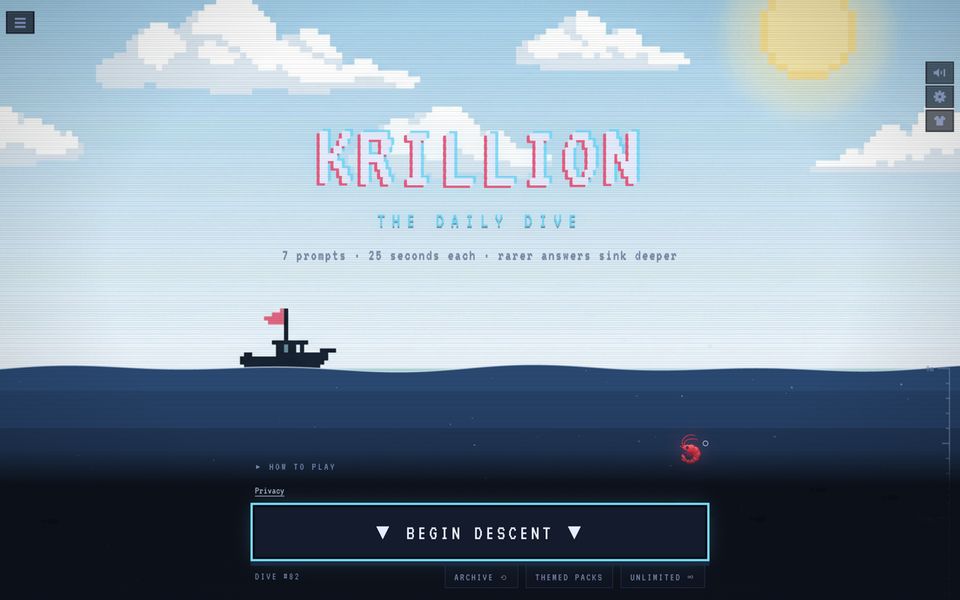
Dictionaries treat these words as informal placeholders. They never appear in equations, never count anything, and have no agreed value. That is the entire joke of the name — and, as it turns out, a perfect name for a game about rarity. The top tier even borrows the phrase: One in a Krillion.
Words that sound like numbers but aren't
English has a whole shelf of fake number words. They all follow the same recipe: borrow the rhythm of million and billion, swap in a funny syllable.
| Invented word | What it conveys | Real value |
|---|---|---|
| zillion | a huge, vague amount | none |
| jillion | a huge, vague amount | none |
| gazillion | an even huger, vaguer amount | none |
| bajillion | hyperbole, usually spoken aloud | none |
| krillion | hyperbole with a sea-creature twist | none |
Notice what they share: none of them can be pinned down. If a word can't answer “how many, exactly?”, it isn't a number — it's a costume that a number wears.
Where the fake family comes from
The pattern is old and endlessly productive. “Zillion” is attested by the early twentieth century as a joking inflation of million; jillion, gazillion and bajillion followed like cousins at a reunion, each new syllable turning the dial of exaggeration one more notch. Linguists call words like these indefinite hyperbolic numerals — they have the grammar of a number (you can pluralize them, multiply them, be “down to your last zillion”) and none of the arithmetic.
That productivity is why the family keeps growing. Any speaker can mint one and be understood instantly, because the recipe — famous number suffix plus nonsense prefix — carries the meaning by itself. “Krillion” slots straight into that tradition, with a whiff of krill for the deep-sea theme. It is exactly the kind of word a trivia game about rarity deserved.
When billion itself was ambiguous
Here's the twist: even a real number word has caused worse confusion than any zillion. For centuries, Britain and much of Europe used the long scale, where a billion meant a million million (10¹²), while the United States used the short scale, where a billion is a thousand million (10⁹). The same word, two meanings, a thousandfold apart — newspapers and parliaments stumbled over it for decades.
The UK government finally switched its official statistics to the short scale in 1974, and most of the English-speaking world followed. But the scar remains in old headlines and translated documents. So before you laugh at “krillion” for meaning nothing, remember: “billion” once meant two different things to two native speakers arguing in the same language. Fake numbers are honest about being vague; real ones have pretended to be precise while quietly forking.
Why fake words make real brand names
Invented number words have a proud second career as brand names. Google began as a misspelling of googol — the ten-to-the-hundredth number — typed in a hurry and kept because the domain was free. Yahoo was a brute creature borrowed from Gulliver's Travels. The pattern works because an invented word is searchable: type it into any engine and it means one thing only.
“Krillion” follows the same playbook with a twist of krill. As a game name it's ownable, memorable, and — in a piece of naming luck few brands get — it comes with its own scoring philosophy baked in: the rarest find is, literally, one in a krillion. The top tier's story and the game's name are the same story.
Where the real numbers actually stop
The real naming system is boring and beautiful: million (10⁶), billion (10⁹), trillion (10¹²), quadrillion (10¹⁵), and on up the Latin ladder — every one with an exact value. Beyond them sit the named giants: a googol is 1 followed by a hundred zeros, and a googolplex is 1 followed by a googol zeros — more digits than fit in the observable universe.
Everything with a real definition lives on that ladder or its extensions. “Krillion” is what you get when you step off it on purpose — which is exactly the spirit of the game's 100-point tier: an answer so rare it's one in a krillion.
Why the game is called Krillion
The game scores answers by rarity, and its best tier is reserved for an answer almost nobody else typed. In ordinary speech you'd call that “one in a zillion.” Renaming it “one in a krillion” does two jobs at once: it keeps the meaning of absurd rarity, and it makes the phrase the game's own.
So when a prompt asks you to name something and you dig up an answer so specific that almost nobody joins you — you've just made the word real for a moment. The number is fake; the rarity is not. Our rare answers record logs every 100-point catch.
The only numbers that matter while playing
The game itself runs on very real, very small numbers: seven prompts a day, about 25 seconds per prompt, six tiers worth 10 to 100 points, and one point equalling ten metres of dive depth. The scoring guide has the full arithmetic — no krillions were harmed in the calculation.
If you came for the trivia answer: no, not a real number. If you came to play — here's how, and the daily reset lands at 04:00 UTC.
Questions people ask
Is a krillion a real number?
No. “Krillion” is an informal, invented number word — a stand-in for a huge, unspecified amount, like zillion, jillion or gazillion. It has no defined value and never appears in mathematics.
What does “one in a krillion” mean?
It is a play on “one in a zillion”: something so rare it is almost unique. That is also the name of the game's top scoring tier — an answer almost nobody else typed, worth the full 100 points.
What is the largest real number with a name?
A googol is 10 to the 100th power, and a googolplex is 10 to the power of a googol — both real, both named. “Krillion” sits outside that family: it is a joke word, not a quantity.
Why do people say zillion instead of a real number?
Because precision is the enemy of exaggeration. Saying “a trillion” commits you to a specific, countable amount; saying “a zillion” says only: too many to bother counting, and more than you think. Fake number words exist so conversation can gesture at magnitude without promising arithmetic.
Part of the Hints4Today logbook — every guide in one place.
Hints4Today is an independent fan site and is not affiliated with the creators of Krillion. Screenshots of the official game are copyright krillion.io and appear here solely for identification and commentary (fair use). Play the official game at krillion.io.
🐋 Done diving? Whallion — our bonus game where the rarer answer feeds the whale. Hand still warm? Put it to work.