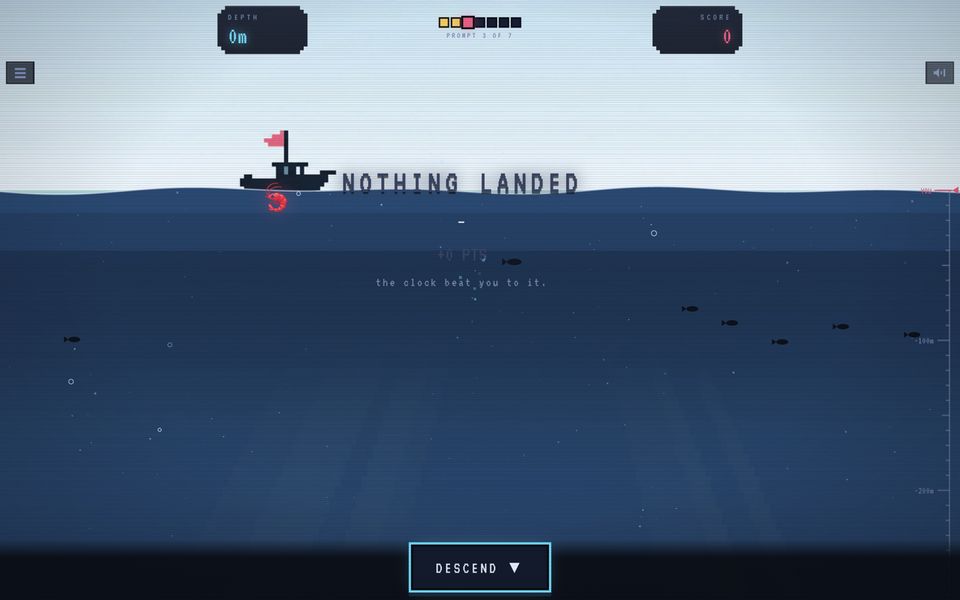
The arithmetic of perfect
The tiers are fixed: Plankton 10, Too Clever 15, Schooler 30, Rare 60, Deep Cut 85, and One in a Krillion 100. Seven prompts, one answer each, so the ceiling is 7 × 100 = 700 points. Multiply by ten metres per point and the perfect dive bottoms out at 7,000 m — the full scoring breakdown walks the ladder rung by rung.
You can rehearse the arithmetic on the score calculator — try seven Deep Cuts (595) and feel how one Plankton instead of a zero already changes the shape of your day.
Why nobody cruises to it
Three forces push back. First, the clock: about 25 seconds per prompt is enough time for the obvious answer and precious little else. Second, the rejection rule — an answer outside the official pool scores 0, and 100-point hunting means going specific, which is exactly where rejections live (see why answers get rejected).
Third, rarity is a crowd property. Your answer only pays 100 if almost nobody else typed it — meaning a perfect run requires being unusual seven times in a row, on prompts the whole planet plays the same day. The median prompt pool we've recorded holds under a hundred answers; on prompts that narrow, the space of valid guesses is tiny and one wrong certainty sinks the run.
The realistic path to the abyss
The pros don't chase 700; they chase a high floor. The math is lopsided in your favor: moving one answer from Plankton (10) to Rare (60) is worth +50, while gambling that same slot on a maybe-rejected wonder is worth −10 or worse. Read every prompt's pool size first — our hints page publishes them with historical percentiles — and spend your risk where pools are narrow and the 100-point words actually live.
- Bank the wide pools early with safe, valid answers.
- Spend your creative seconds only on narrow pools.
- Accept Schooler over a coin-flip Deep Cut on the last prompt.
- Post-dive, read what the 100-point words were — the pattern compounds daily.
The depth zones on the way down
| Score | Depth | What it says about your dive |
|---|---|---|
| 0 | 0 m | Every answer rejected — the boat, basically |
| 1–99 | 10–990 m | Surface waters; a few safe picks landed |
| 100–299 | 1,000–2,990 m | Twilight zone — a solid daily dive |
| 300–499 | 3,000–4,990 m | Midnight zone; rare answers are landing |
| 500–699 | 5,000–6,990 m | The abyss — six or seven genuinely rare finds |
| 700 | 7,000 m | The trench floor; seven One-in-a-Krillion answers |
The zones tell you where the crowd lives: most players surface somewhere between the twilight and midnight zones, which is exactly why a 500+ day feels like a different sport. The calculator maps any seven picks onto this ladder in one tap.
700 points in the real ocean
The game's depth metaphor maps onto the actual ocean, and the comparison is better than decoration:
| Real depth | What lives there | Game equivalent |
|---|---|---|
| 200 m | The sunlight zone ends; plants stop photosynthesising | 20 points — one Plankton answer |
| 1,000 m | Midnight zone begins; sunlight never reaches this far | 100 points — a solid dive starts |
| 3,800 m | The Titanic rests at about this depth | 380 points — Rare answers landing |
| 6,000 m | The hadal zone begins — trenches only | 600 points — Deep Cut territory |
| 7,000 m | Deep hadal water; deeper than the Titanic by miles | 700 points — the perfect run |
| 10,935 m | Challenger Deep, the ocean's floor | Beyond the game — no diver has gone further |
So a perfect Krillion run doesn't just top the leaderboard — it sinks the diver past the Titanic and into water only trench creatures call home. The ceiling is deliberately just out of reach of the real ocean's floor: even perfection leaves you three thousand metres above Challenger Deep.
Where the points actually leak
Break a 700 dream down and the leaks are never exotic. Two Plankton answers where Schoolers were available cost 40 points — that's a tier of depth gone to the two most obvious thoughts you had. One rejection costs whatever the prompt might have paid, plus the tempo: the panic answer that follows a rejection is almost always Plankton. Run your own dives through the calculator and the pattern is blunt — most lost points aren't lost to ambition, they're lost to typing the first thing that came to mind on a wide pool.
Practice runs cost nothing
The cheapest way to train for a deep dive is the one most players skip: after the clock ends, take the same prompts back through the calculator and ask what the dive you wanted would have scored. Guilt-free experimentation is the only unlimited mode that's free — and it's where most of the instinct for the trench floor is actually built.
The math of near-perfect
Here's a fact that keeps perfection honest: seven Deep Cut answers — an extraordinary dive by any human standard — total 595 points, which doesn't even reach the abyss zone's 6,000-metre floor. You cannot cross 600 without at least one One in a Krillion. The zone table isn't decoration; it's a proof that the top tier is structurally required, not optional garnish.
Run the permutations and the shape of the ceiling appears: six perfect answers plus one rejection is also 600 — identical to a dive with six hundreds and a zero. One mistake and one missing masterpiece cost the same. That symmetry is the game's cruelest joke: the trench floor demands seven miracles, and forgives none.
If you still want the 700
Treat it as a season, not a session. Study the rare answers record to learn the flavor of 100-point picks — real-but-obscure, never invented. Use the first-letter clues on the hints page to pre-load one specific candidate per category. And accept the truth in the name: a perfect run is, fittingly, one in a krillion.
Questions people ask
What is the highest possible Krillion score?
700 points — seven prompts at the top rarity tier of 100 points each. Each point equals ten metres of depth, so a perfect run sinks you 7,000 metres to the trench floor.
Has anyone scored 700 in Krillion?
There's no public leaderboard, so perfect runs can't be verified from outside — which is part of the design. What the math says: it requires seven One-in-a-Krillion answers in one dive, with about 25 seconds per prompt and zero rejections.
What is a good daily Krillion score?
Anything above 300 points (3,000 metres) means you're landing Rare-or-better answers consistently. The scoring math favors a high floor: one rejected answer costs a full prompt, so seven accepted answers beat six brilliant ones and a zero.
What score do most players actually get?
There is no public average, but the zone math suggests most comfortable divers live between the twilight and midnight zones — a few hundred points. Crossing 500 means six or seven genuinely rare answers in one dive, which is rare precisely because it requires both knowledge and discipline under the clock.
Part of the Hints4Today logbook — every guide in one place.
Hints4Today is an independent fan site and is not affiliated with the creators of Krillion. Screenshots of the official game are copyright krillion.io and appear here solely for identification and commentary (fair use). Play the official game at krillion.io.
🐋 Done diving? Whallion — our bonus game where the rarer answer feeds the whale. Hand still warm? Put it to work.