The one-line difference
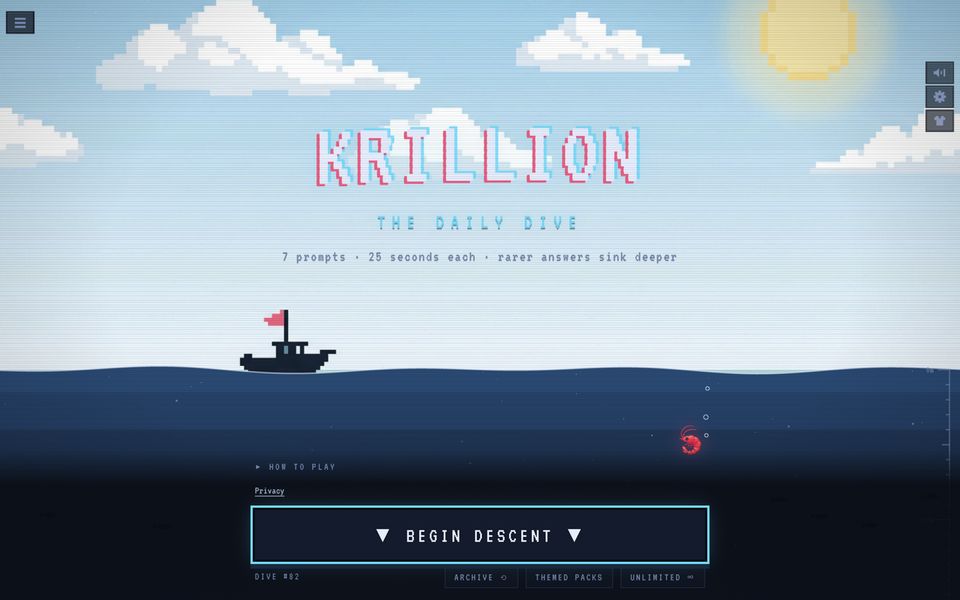
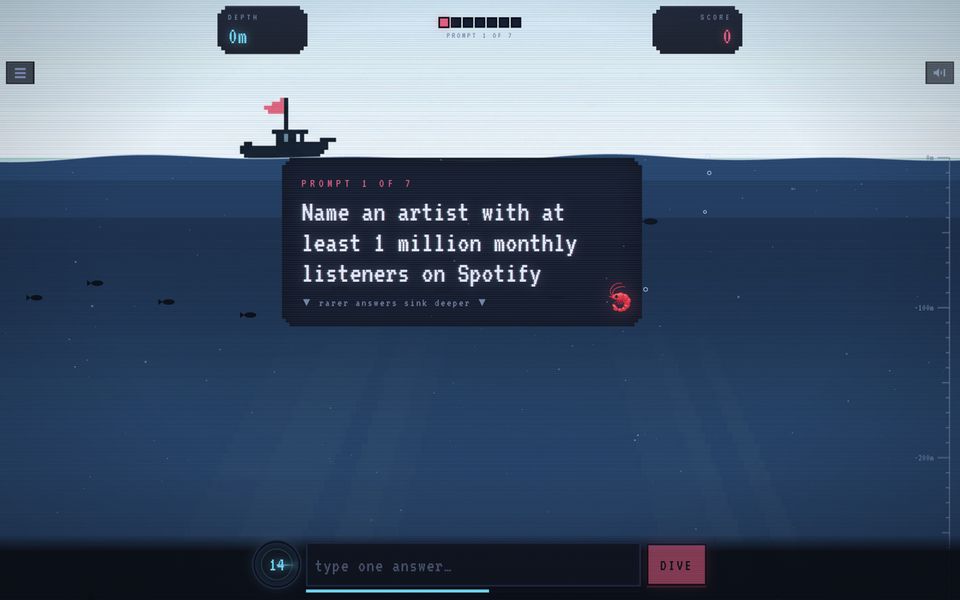
In Wordle, the game hides a single five-letter word and you chip at it with guesses and tile colors. In Krillion, nothing is hidden: you get seven open prompts — “name a TV brand,” “name a part of a fruit” — and the game scores each answer by how rare it is inside the official answer pool. One game asks can you find it?; the other asks can you find a version of it nobody else thought of?
Side by side
| Wordle | Krillion | |
|---|---|---|
| Format | One hidden 5-letter word | Seven open-ended prompts |
| Feedback | Green/yellow/gray tiles per guess | A rarity tier and points per answer |
| Scoring | Fewer rows = better; streaks | Rarity points (10–100) × 7; points become depth |
| Clock | No limit per guess | About 25 seconds per prompt |
| A miss | Six rows, then the word is revealed | A rejected answer scores 0 for that prompt |
| Reset | Midnight local | 04:00 UTC — same dive for everyone |
| Extras | Free, in NYT Games | Free daily dive; Unlimited mode $5 once |
| Trains | Deduction, letter logic | Recall, breadth, fast rarity judgement |
The reset difference matters more than it looks: one dive per calendar day, identical for the whole planet. Our daily answers page publishes each dive's prompts and pool sizes right after the reset.
Bloodlines: a gift, then a gold rush
Wordle has a love story attached: engineer Josh Wardle built it for his partner in October 2021, it escaped into the world, and by January 2022 the New York Times bought it for an undisclosed low-seven-figure sum and parked it in NYT Games. Every daily game since has lived in its shadow — and borrowed its ritual.
Krillion arrived in the summer of 2026 — our archive's first recorded dive is July 16, 2026 — and by August the search volume for its name had gone vertical as the word-of-mouth wave rolled. It's the same lineage, different organ: Wordle replaced the crossword for ten minutes; Krillion replaces the pub quiz. The dive-by-dive archive keeps the whole run.
What Wordle players will recognize instantly
- A one-a-day ritual with a shared puzzle — comparing scores is half the fun.
- A clean browser page, no account, no install.
- A shareable result — Wordle's emoji grid, Krillion's depth score.
- The “one more thought” itch: the answer you didn't type will haunt you.
If your morning currently belongs to Wordle, the migration cost is roughly zero. The rules take two minutes to learn; the scoring tiers take one more.
What will feel genuinely new
No feedback loop. Wordle answers you after every guess; Krillion gives you a prompt, a clock, and your own brain. There is also the rejection rule — an answer only counts if it sits inside the official pool, which is why a “reasonable” guess can score zero while a specific one banks 85 points. That rule has its own guide: why Krillion rejects answers.
And the scoring rewards the opposite instinct from a spelling puzzle: the crowd's first thought is worth the least. The deep strategy — going specific instead of clever — is covered in the Too Clever breakdown.
Two scoring philosophies
Wordle scores like a pass/fail exam with style points: you either solve the word or the word solves you, and the streak is the trophy. Krillion has no fail state at all — every accepted answer pays something, and your score is a continuous number that becomes depth. One game asks did you get it?; the other asks how deep did you go?
That difference changes the daily mood. A lost Wordle is a flat bad day; a shallow Krillion dive is still seven small contests, several of which you probably won. And because rarity is relative to the crowd, Krillion rewards knowing what everyone else will say — a tiny sociology experiment running on a 25-second clock, as the scoring guide unpacks.
The sharing cultures
Wordle turned its answer grid into a spoiler-free emoji mosaic — a score you can post without ruining anything. Krillion's shareable artifact is the depth score: “3,240 m” says everything and nothing, a number your group chat will demand context for. One game optimized its share for mystery, the other for bragging. Guess which one starts more arguments. It helps that both games make the score legible to strangers — a number, a streak, a depth — without spoiling a single answer for anyone who hasn't played yet.
Which one should you start with?
Be honest about what you want from five morning minutes. If you like puzzles that narrow — eliminating possibilities, forcing deductions, ending in certainty — Wordle is your sport, and Krillion will feel like being graded on trivia you never revised for. If you like games that open — no single right answer, a hundred valid ones ranked by how few people saw them — Krillion is the one, and Wordle will feel like doing arithmetic when you could be arguing in a pub.
The honest recommendation for Wordle veterans: give Krillion a week. The first two dives feel strange because there's no feedback loop; by the third you start reading pool sizes like tile colors, and by the fifth the morning isn't complete without both. The rituals stack, they don't compete — and the daily hints page slots into the same coffee-slot as your Wordle streak.
Playing both
Plenty of people do: Wordle for the deduction warm-up, Krillion for the trivia sprint. If you want a wider rotation, we keep a shelf of games like Krillion; and if you want the numbers behind every prompt you've answered, the prompt statistics page has every pool size on record.
Questions people ask
Is Krillion like Wordle?
Same ritual, different sport. Both are free, once-a-day browser games with a shared puzzle for everyone. But Wordle is deduction — one hidden five-letter word with tile feedback — while Krillion is rarity: seven open-ended prompts, each scored by how few people typed your answer.
Is Krillion free?
Yes — the daily dive is completely free, no account needed. An optional one-time $5 unlock, Krillion Unlimited, adds an endless mode; the daily dive stays free either way.
Which game is harder?
Different hard. Wordle stresses letter logic under limited rows; Krillion stresses recall, breadth of knowledge and judging rarity in about 25 seconds per prompt — plus the risk that a rejected answer scores zero.
Can you play Wordle and Krillion on the same day?
Yes — both are once-a-day games, not rivals for the slot. Wordle takes about five minutes, a Krillion dive about three, and many players run them back to back: deduction first, then the trivia sprint.
Part of the Hints4Today logbook — every guide in one place.
Hints4Today is an independent fan site and is not affiliated with the creators of Krillion. Screenshots of the official game are copyright krillion.io and appear here solely for identification and commentary (fair use). Play the official game at krillion.io.
🐋 Done diving? Whallion — our bonus game where the rarer answer feeds the whale. Hand still warm? Put it to work.